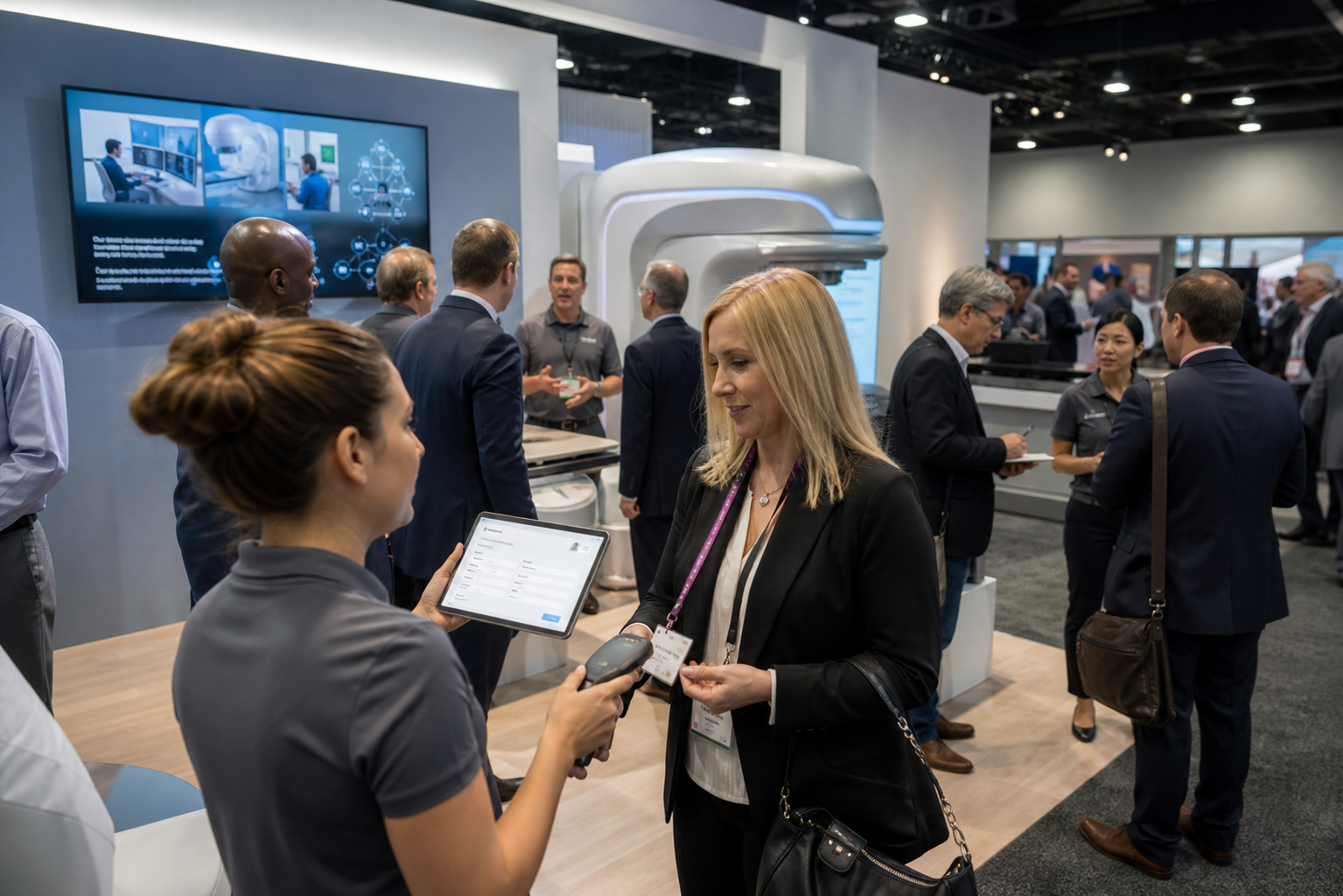
A conference costs a medical device team weeks of planning, a booth, travel and the time of its best reps. Yet the week after the show is often when the value leaks out. Leads sit in a scanner export, the right rep never hears about the surgeon who asked for a demo, and three months later nobody can say what the event produced.
Most of that is decided before the doors open. Here is the playbook we use with clients, split into what to do before, during and after the show.
Before the show: decide what a good lead looks like
1. Agree on the fields with sales. Sit down with the sales leader and agree what a rep needs to follow up well. For medical device buyers that usually means role, specialty, institution, product interest and how soon they want to talk. Set up the scanner or app to capture exactly those, and nothing that nobody will use.
2. Make interest a pick list, not a note. Free text notes are hard to route and impossible to report on. Give booth staff a short list of choices for product interest and next step, such as "wants a demo", "send clinical data" or "talk to a rep".
3. Record follow up consent at the booth. Capture whether the visitor agreed to hear from you, and carry that through to your marketing system so nobody is emailed without it.
4. Set the event name before the first scan. Every lead should carry the event name and year from the moment it is captured. This is what later lets you tie a meeting, an evaluation or an order back to the show.
5. Decide who gets which lead. Write down the routing rules in advance: by territory, by product line or by account owner. If a visitor is already a contact or works at a customer account, the lead should go to the rep who owns that relationship.
6. Run test scans through the whole path. A week before the show, push a few test leads from the scanner into your marketing system and on into your CRM. Check that every field lands in the right place, that a returning contact updates the existing record instead of creating a new one, and that the right rep is notified.
During the show: watch it, don't wait for it
7. Name an owner for show week. One person checks each evening that leads are arriving complete, and fixes problems that day. A field mapping error found on day one costs minutes. Found after the show, it costs days of clean up.
8. Send hot leads to reps the same day. A visitor who asked for a demo should not wait for the show to end. Route those leads to the rep straight away, so the follow up can happen while the conversation is still fresh.
9. Keep booth notes short and consistent. Ask staff to use the pick lists and add one line of notes at most. The point is a lead a rep can act on, not a transcript.
After the show: follow up, then count
10. Follow up within an agreed time. Agree with sales how fast each type of lead gets a personal follow up, and make the CRM show which leads are overdue. Speed matters most in the first week, when the visitor still remembers the booth.
11. Send a short, relevant email sequence. Visitors who are not ready for a call should still hear from you: a thank you with the material they asked for, then one or two useful follow ups tied to their product interest. Respect the consent captured at the booth.
12. Report what the event produced. Two to three months later, pull a simple report by event name: how many leads, how many meetings, how many evaluations or trials, and how much pipeline. Set this against what the show cost, and you have a real basis for deciding which events to grow and which to drop.
What this looks like in practice
GammaTile, which makes an FDA-cleared radiation therapy for operable brain tumors, used to upload conference leads by hand after each show. We connected their lead capture app, HubSpot and Salesforce, tested the whole path before the event and watched it during the show. On our home page we report 43% fewer duplicate conference lead records as a result. The full story is in the GammaTile case study.
Where to start
If your team still cleans up event leads by hand, or cannot say what last year's shows produced, a 30-minute CRM assessment is a good place to start. With 18+ years of CRM consulting on HubSpot and Salesforce, we will look at how leads move from your booth to your pipeline and tell you plainly what is worth fixing before your next show.
Get in touch for a 30-minute CRM assessment